
Advancing National Workplace Safety Through Research and Policy
Investments in The George Washington University
(2019–2026)
Introduction
The McElhattan Foundation's Ending Death on the Job (EDOJ) program is guided by a clear vision: eliminate workplace fatalities by 2050. Central to that vision is the belief that preventing workplace deaths will require greater public awareness and smarter policy, not just stronger responses after a fatality occurs. That belief has shaped the Foundation's long-term partnership with The George Washington University (GW), which has focused on the systems that determine how workplace fatalities are understood, measured, reported, and prevented across the United States.
The partnership began in 2019, when the Foundation made its first investment in GW and in the work of Dr. David Michaels and Dr. Gregory Wagner. Dr. Michaels served as Assistant Secretary of Labor for the Occupational Safety and Health Administration (OSHA) from 2009 to 2017 during the Obama administration, making him the longest-serving administrator in the agency’s history. Before that, he served as Assistant Secretary for Environment, Safety and Health at the U.S. Department of Energy from 1998 to 2001 during the Clinton administration. Dr. Wagner brought complementary expertise in occupational medicine, epidemiology, and federal worker protection leadership. He held senior roles at the National Institute for Occupational Safety and Health (NIOSH), including directing the Division of Respiratory Disease Studies and the mine safety and health research program, and later served as Deputy Assistant Secretary of Labor for the Mine Safety and Health Administration (MSHA). Together, they were exceptionally well positioned to examine how federal and state systems could do more to prevent workers from being killed.
In 2019, GW's original proposed project, Preventing Work Fatalities in the Rapidly Changing World of Work, was designed to examine patterns of workplace death and identify where intervention might have the greatest effect on national prevention efforts. As such, the Foundation was not exclusively funding research; it was investing in the idea that ending death on the job would require changing how workplace safety is understood at a national and systemic level.
At its core, this project and the two subsequent grant-funded projects asked why, despite decades of progress since the Occupational Safety and Health Act of 1970, more than 5,000 workers were still dying on the job each year.
The following sections highlight the main ways this partnership advanced the Foundation’s EDOJ program over time. Though the work began with the previously mentioned project, in 2020, when the grant was disbursed, that plan shifted almost immediately toward COVID-19 as the pandemic became an urgent workplace safety crisis. In 2022, the Foundation renewed and expanded the work through a three-year grant focused on preventing work fatalities during and after the pandemic. By 2023 and 2024, the project focused more on heat, wildfire smoke, silica, diesel exhaust, business engagement, and data infrastructure. By 2025 and 2026, the work had expanded again to include public OSHA injury data dashboards, continued journalism and policy engagement, and support for the Weekly Toll (a weekly compilation of workplace deaths reported in the local news). Taken together, these investments, summarized in Table 1, total more than $2.6 million in support for work that has helped shape national conversations about workplace safety.
| Grantee | Grant Cycle | Grant Duration | Grant Amount |
|---|---|---|---|
| The George Washington University | FY 2020 | Two years | $631,658 |
| The George Washington University | FY 2022 | Three years (extended to four) | $1,542,719 |
| The George Washington University | FY 2026 | One year | $512,000 |
Table 1: Summary of Grants to the George Washington University
The Investment: Research and Public Leadership for Workplace Fatality Prevention
Highlights:
Helped advance national COVID-19 prevention recommendations, including free N95 masks and rapid antigen tests, that were later adopted by the federal government.
Produced the first nationwide estimate showing that extreme heat contributed to approximately 28,000 additional workplace injuries in 2023, helping elevate heat as a major worker safety issue.
Developed publicly accessible OSHA injury and fatality data dashboards, making workplace safety data more accessible and actionable for researchers, journalists, regulators, and public health professionals.
Influenced national workplace safety policy and public understanding through congressional testimony, National Academies panels, major scientific publications, and extensive media engagement.
Pivoting to COVID-19
When the first grant officially began on January 1, 2020, COVID-19 was not yet the focus of the project. Within weeks, however, reports from hospitals, long-term care facilities, meatpacking plants, and other “essential” workplaces revealed that the pandemic had become a worker safety crisis. The GW team quickly shifted from retrospective fatality prevention research to urgent public education and policy work focused on reducing workplace transmission of SARS-CoV-2. The team recognized that worker safety could not be treated as a secondary concern and that healthcare workers, food system workers, delivery workers, and others in essential roles were facing disproportionate risk while much of the country relied on them to keep everyday life functioning.
During this time, Dr. Michaels and Dr. Wagner became important national voices on worker protection during the pandemic. Dr. Michaels was appointed to the Biden-Harris Transition COVID-19 Advisory Board in 2020, where he helped shape the incoming administration’s workplace safety response. He and Dr. Wagner published papers in the Journal of the American Medical Association (JAMA) and the British Medical Journal (BMJ) on OSHA’s role during the pandemic and on a national COVID-19 mitigation strategy, and they later helped produce analyses intended to inform future pandemic preparation. They also served on expert panels convened by the National Academies of Sciences, Engineering, and Medicine, including one that developed a framework for equitable vaccine allocation and another that made recommendations about respiratory protection for the public and workers without formal respiratory protection programs. They also participated in the Lancet COVID-19 Commission Task Force on Safe Work, Safe School, and Safe Travel, the National Academy of Social Insurance COVID-19 Task Force, and the GW COVID-19 National Health Care Worker Survey.
Moreover, Dr. Michaels and Dr. Wagner wrote for scientific journals and major public outlets, spoke at professional meetings and worker-facing events, testified at congressional hearings, and responded regularly to national media, including the New York Times, the Wall Street Journal, the Washington Post, NPR, Marketplace, PBS NewsHour, CNN, MSNBC, Time, Politico, and others. This public-facing role was not separate from the research; it was one of the main ways the project created impact. The work was designed not only to document risk, but also to move information to employers, government agencies, journalists, and the broader public.
In 2021 and 2022, as national attention turned to vaccination and testing, Dr. Michaels and his coauthors used JAMA and other public platforms to push for stronger prevention measures. In one JAMA commentary supported by the first grant, they urged the federal government to make high-quality N95 masks and rapid antigen tests available to the public at no cost. These recommendations were shared with White House officials before publication, and within weeks both were adopted nationally. The team also helped write Getting to and Sustaining the Next Normal: A Roadmap for Living with COVID, taking primary responsibility for chapters on worker safety and cleaner indoor air.
The GW team also helped shift public understanding of how COVID-19 spread. By emphasizing that SARS-CoV-2 was transmitted through the air—not only through larger droplets—the work helped move the conversation beyond individual behavior and toward workplace conditions such as ventilation, filtration, disinfection, and respiratory protection. That distinction mattered because it changed what prevention required and highlighted that it was not enough to tell workers to distance or wear any mask; workplaces needed cleaner indoor air and policies that treated exposure as a preventable workplace hazard.
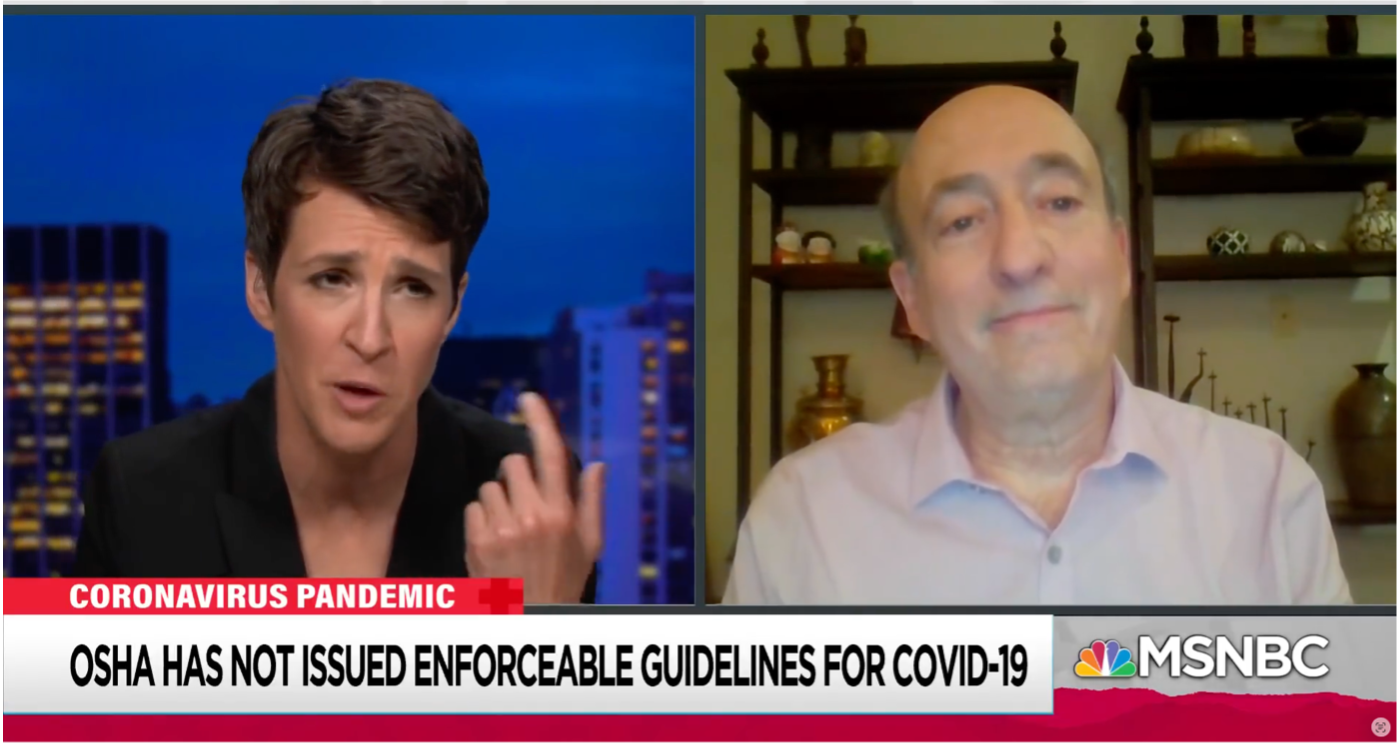
Image 1: David Michaels discusses OSHA’s response to COVID-19 worker safety risks on MSNBC’s The Rachel Maddow Show in May 2020.
Shifting the Focus to Emerging Hazards
The Spring 2022 grant extended the partnership beyond the emergency phase of the pandemic and created space for the team to return to the broader fatality prevention project. At this time, as COVID-related work began to taper, the team increasingly focused on hazards placing workers at greatest risk beyond the virus, including extreme heat, wildfire smoke, silica exposure, and diesel exhaust. Heat became a central focus because it disproportionately affects workers whose jobs must be done in person and often outdoors, including agriculture, construction, transportation, amongst other sectors. By 2024, this climate-related worker safety work had become more visible: Dr. Michaels served on the National Commission on Climate and Workforce Health, wrote on heat and wildfire smoke, and delivered a keynote address to the G20 Occupational Safety and Health Network on protecting workers from extreme heat.
Using OSHA injury records and high-resolution climate data, the GW team helped produce the first nationwide estimate of how much heat contributes to workplace injury (as illustrated in Figure 1). The analysis focused on injuries reported in 2023 and found that an estimated 28,000 additional injuries that year were attributable to heat . That number helped raise awareness about a hazard that is often discussed in anecdotal terms but rarely quantified more visible on a national scale. It also arrived as OSHA was considering a proposed heat standard, giving the research immediate practical relevance and giving journalists and policymakers a clearer way to understand the scale of the problem. As Dr. Michaels shares:
“Just like during COVID, when many executives and white-collar workers could work safely from home while ‘essential workers’ risked their lives, heat disproportionately affects workers with less power and ability to control their environment. Many people who work in the comfort of air conditioning are barely aware of the dangers and challenges facing outdoor and indoor workers who must perform physical labor in extremely hot environments.” — Dr. David Michaels
Additionally, the team focused on silicosis among workers who fabricate engineered stone countertops, a growing and preventable crisis that has caused severe disease and deaths among hundreds of workers exposed to high levels of silica dust. They also worked on diesel exhaust and lung cancer, using new scientific findings to argue for more worker protection. Across these issues, the project linked science and policy relevance so that emerging hazards could be recognized before more workers were harmed.
In 2025, following budget cuts to NIOSH and OSHA, Drs. Michaels and Wagner spoke with journalists across multiple outlets to explain the likely consequences for worker safety. Their efforts achieved coverage in major media publications and the resulting public attention contributed to the restoration of several NIOSH programs and the decision not to close the Chemical Safety Board or any OSHA offices.
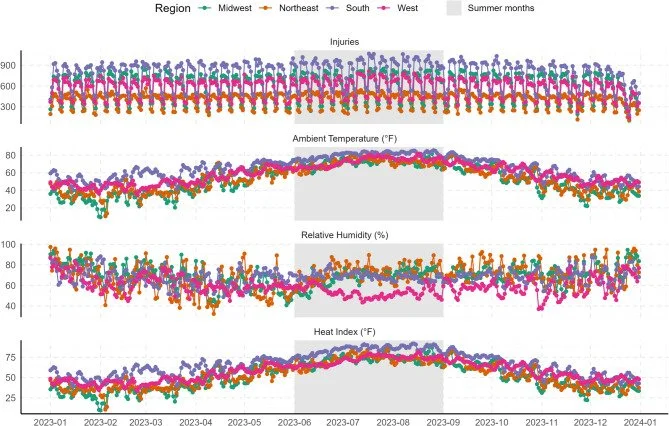
Figure 1: The GW team’s heat and workplace injury analysis tracks daily injuries alongside environmental exposures from January 1 to December 31, 2023; the x-axis shows date, while the y-axes show daily injury counts, temperature, relative humidity, and heat index.
Building Data Infrastructure
A second major area of impact has been the development of data tools and data strategy for prevention, which became a central focus of the Spring 2022 grant. The 2022 proposal established that existing occupational safety data systems were not sufficient to understand serious injuries, near misses, work-related illnesses, and fatalities. The team proposed bringing together occupational health experts and data scientists, examining data held by OSHA, NIOSH, MSHA, the Bureau of Labor Statistics, workers’ compensation systems, and state and local agencies, and identifying where traditional data could be linked with other sources such as Medicare, EPA, USDA, Department of Transportation, Department of the Interior, and Consumer Product Safety Commission data.
This work built on Dr. Michaels’ earlier experience at OSHA, where a 2010 workshop helped generate two important data programs: the severe injury reporting program and the collection of summary injury and illness data from many thousands of establishments and injury case data from injuries among workers employed at large establishments. The project also drew on MSHA’s “Rules to Live By” initiative, which showed how data could point agencies toward the hazards most in need of attention. If fatality and inspection records showed that the same kind of violation kept appearing in serious incidents, MSHA could use that information to guide inspector training, employer outreach, and enforcement priorities. In that sense, the data were not only documenting what had already gone wrong; it was helping the agency decide where prevention efforts should go next.
As of 2025, the centerpiece of the current data effort is a publicly accessible dashboard for OSHA’s workplace injury data, covering approximately 900,000 injuries reported in 2023, and to make the tool useful, the team gathered feedback from 31 experts and refined the dashboard based on their input. Furthermore, the dashboard was designed for people outside the research community, including journalists investigating workplace hazards, state OSHA plans targeting inspections, advocates, and public health departments tracking community health risks.
The 2026 phase of the work extends this data infrastructure further and the GW team plans to develop a second dashboard covering approximately 72,000 workplace deaths reported to OSHA since 1984. The ongoing project will geocode fatalities and link them to same-day temperature and weather conditions at high spatial resolution, enabling analyses of heat-related fatality risk across industries, geographies, and time periods. The data work has also become a way for mentoring the next generation of occupational health researchers. Dr. Barrak Alahmad, a research scientist at Harvard, is being supported in his transition from early-career to mid-career leadership through the project, while Alia Jamil, a Master’s student at GW, has led development of the dashboard’s backend and is being trained in data management, analysis, and applied occupational health research. Reflecting on the data effort, Dr. Wagner shares:
“You can’t just keep it [workplace fatality data] in your hands… you can’t only write an editorial in JAMA… you need to be able to spread information in a way that it’s useful to educate and motivate others who can make a difference.” — Dr. Gregory Wagner
Shaping Public Discourse
Throughout the 2019–2026 partnership, a consistent thread has been the project’s role in shaping how the employers and the public at large think about workplace safety. Particularly, in 2023, Dr. Michaels published in the Harvard Business Review, reaching business leaders with a core message: managing for safety is not a cost, but part of running an organization well. In 2024, he extended the same argument in the MIT Sloan Management Review, and by 2026 the work was developing into a forthcoming book with the University of Chicago Press aimed at a broader business audience.
The GW team has also worked directly with journalists to ensure that workplace safety stories are framed accurately and constructively. For example, when the Washington Post investigated a dangerous lumber mill in Alabama where numerous workers had been killed or severely injured, Dr. Michaels worked with the reporter to shift the narrative from “OSHA is an incompetent agency” to “OSHA needs stronger tools to prevent deaths.” When a member of Congress introduced legislation to abolish OSHA, Dr. Michaels worked with Time Magazine to explain the agency's central role in worker protection. These examples show how the partnership helped move public attention from placing blame toward prevention and stronger policy tools.
The Weekly Toll Partnership
The Weekly Toll became part of the partnership in 2026, as GW began serving as a fiscal sponsor for a small allocation to support this related public information effort. The Weekly Toll is a weekly digital report published within Jordan Barab’s widely followed Confined Space newsletter. It lists and describes workplace deaths reported in local news media across the country and is the only publication that compiles these tragedies on a regular basis.
While the OSHA dashboards make injury and fatality data easier for journalists, state agencies, researchers, and public health officials to use, the Weekly Toll keeps the reality of workplace deaths visible to the public week after week. It names workers where possible, describes the circumstances of their deaths, and helps readers see that fatal workplace incidents are not rare or isolated.
Jordan Barab continues to publish Confined Space and the Weekly Toll as an unpaid volunteer, but the grant support allows him to hire a research assistant to scan local news reports and compile fatality items for publication. Because not all workplace deaths currently make it into the Weekly Toll, additional research support would help ensure that more deaths are documented and honored. In this way, the Weekly Toll complements the GW project’s larger research, data, and policy work by preserving the individual stories behind the statistics and reinforcing the urgency of prevention.
The Impact: Making Workplace Fatalities Visible
Through sustained investment, the McElhattan Foundation helped position trusted national experts to shape how the United States understands and prevents workplace deaths. By supporting leadership, credibility, public communication, and data tools— and not siloed approaches —the Foundation helped ensure that expert voices were ready to respond across a range of issues.
From the Fall 2019 grant’s focus on rethinking fatality prevention in a changing world of work, to the 2020–2021 COVID pivot, to the Spring 2022 grant’s emphasis on post-pandemic prevention, data infrastructure, climate-related hazards, and business engagement, this body of work has adapted as the field’s needs have changed. In 2025 and 2026, the work continues through public-facing data tools, policy and media engagement, business-facing writing, and the Weekly Toll. Across each phase, it has remained focused on the same central aim: making workplace deaths more visible, more preventable, and harder to ignore. Together, these investments advance the Foundation’s vision that no worker should die on the job and show why that goal requires sustained attention to public understanding and trusted leadership.
Insights for Funders
For funders, the GW partnership shows that engaging credible experts is what allowed the Foundation’s investment to stay responsive and relevant as workplace safety hazards evolved. Some of the most important outcomes came because the Foundation supported people with the credibility and relationships to respond as the field changed. Dr. Michaels and Dr. Wagner were able to communicate information about COVID-19, heat, silica, and other emerging issues because the grants sustained their capacity to act. This kind of field-building grantmaking creates room for experienced leaders to respond when important opportunities arise, even when those opportunities cannot be predicted in advance during the proposal stage.
Moreover, this case study shows that awareness should be understood as an important outcome of this kind of work, since many of the partnership’s contributions were not direct services to workers but shifts in public understanding of worker protection. The dashboards and the Weekly Toll show how different forms of information can support prevention in different ways. National data can reveal patterns and point to where systems are failing, while the Weekly Toll keeps individual deaths visible. For funders, the question is not only what was produced, but whether the investment helped make prevention more visible and actionable. The GW case also shows the importance of making evidence usable for the people who can act on it. The OSHA injury dashboard matters not only because it organizes a large dataset, but because it makes that information easier for external audiences to use.
Additionally, the partnership shows the importance of clear communication when the work changes: budget underspending, no-cost extensions, pivots, and emerging opportunities were manageable because the GW team and the Foundation maintained transparency to adjust course as the partnership evolved. For grantees, this means explaining not only what changed, but why the change still advances the shared purpose, and, in this case, that shared purpose being eliminating workplace fatalities by 2050.
