
Reel Medicine Media
(2026)
Introduction
McElhattan Foundation’s End-of-Life Planning and Care (EOL) program area is grounded in the belief that good care during serious illness requires more than medical treatment. It calls for care that sees patients as whole people and enables the professionals around them to work across disciplines.
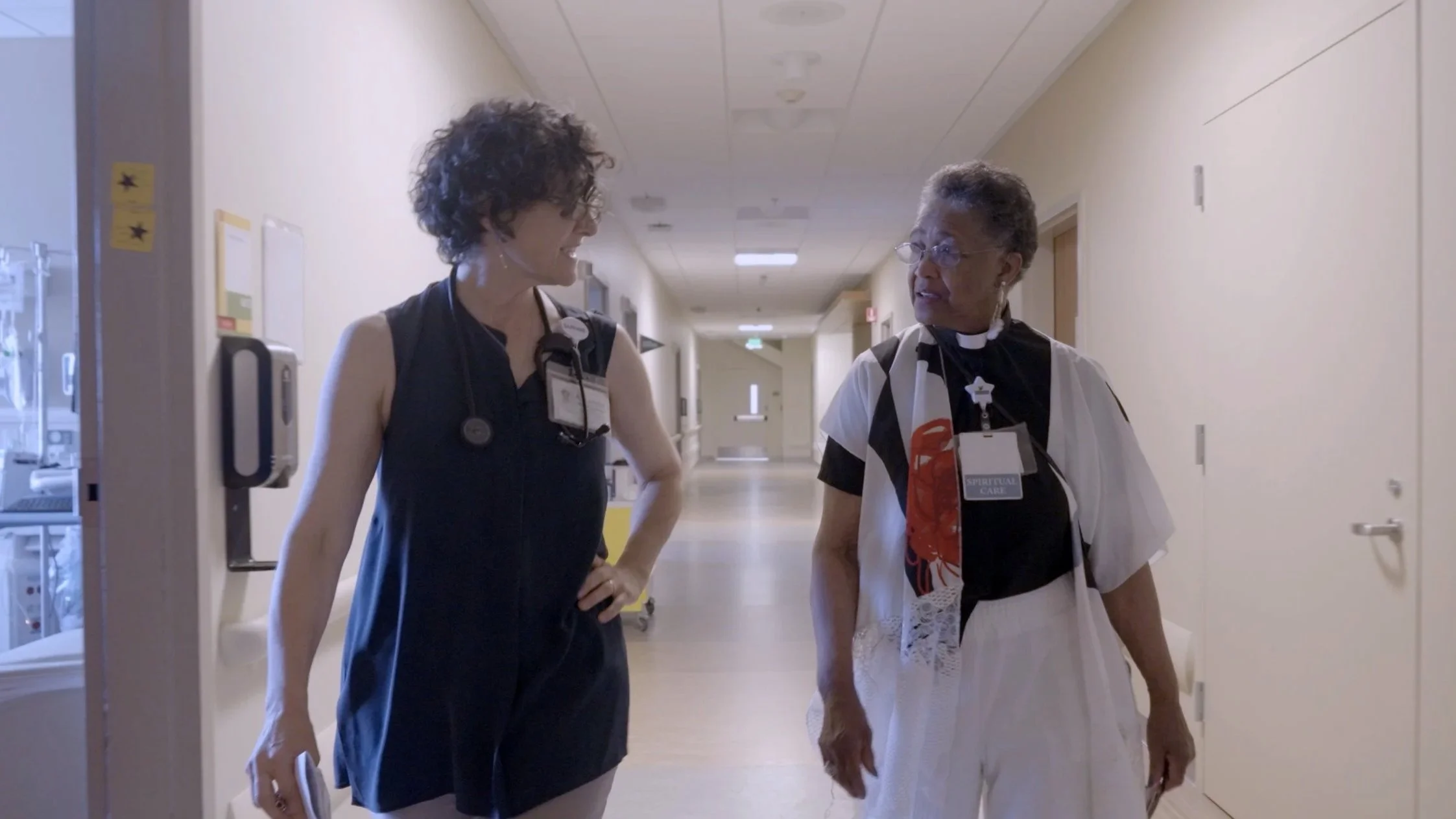
That belief shaped the Foundation’s investment in Reel Medicine Media’s The Chaplain & The Doctor, a feature-length documentary which follows Chaplain Betty Clark and Dr. Jessica Zitter who are longtime colleagues on the Palliative Care service at the Wilma Chan Highland Hospital Campus in Oakland, California.
In the film, Chaplain Clark brings the perspective of spiritual care, while Dr. Zitter, a trained physician, brings one centered on medical intervention. Over more than a decade of working together, each transformed the other’s approach to care. With Chaplain Clark’s guidance, Dr. Zitter began examining the barriers and biases physicians may bring to the bedside, as well as the essential role spiritual care can play for people facing serious illness.
However, when Chaplain Clark begins facing health challenges of her own, their relationship shifts, and Dr. Zitter becomes involved in her care. The physician who learned alongside her now experiences the healthcare system through someone she knows and loves, making the effects of bias on patients immediate and personal. Through their relationship, the film presents serious illness as both a physical and spiritual experience and asks what healthcare could look like if every patient were treated as a whole human being.
The Investment: Using Film to Change the Conversation About Care
Highlights:
Reached nearly 2,500 audience members through a 16-city national screening tour focused on serious illness, spiritual care, and interdisciplinary collaboration.
Delivered three screenings, two keynote presentations, two scene-based workshops, and a pilot advance care planning workshop across Western Pennsylvania.
Engaged more than 200 national champions and partners (20 in Western Pennsylvania) representing over 135 institutions (seven in Western Pennsylvania) to promote screenings and community participation.
Collected early evaluation data showing that more than 90% of viewers reported the film helped them engage with difficult healthcare topics.
In FY26, the Foundation awarded Reel Medicine Media $200,000 to support a national impact campaign built around the film. The investment reflected a broader strategy: creative media can change how people understand and experience care when a compelling story is paired with meaningful engagement. Rather than only screening the documentary, Reel Medicine Media built a campaign that helped audiences connect its themes to their own practice and lived experience.
The campaign brought the themes of The Chaplain & The Doctor into professional and community settings through a national screening tour and focused programming in Western Pennsylvania. Pittsburgh hosted a public screening alongside a series of healthcare education and training programs, while Franklin hosted a community screening the following evening. Because Franklin is also central to the Foundation's Economic Development in Knox and Franklin program area, the event created a natural connection between two areas of grantmaking, extending a national investment in serious illness care while deepening the Foundation's engagement in a community where it had longstanding relationships.
Across both locations, audiences were invited to consider how implicit bias, spiritual care, and interdisciplinary approaches shape the experience of serious illness. Drawing on scenes from the film, Dr. Zitter explored how assumptions can influence clinical decision-making, while Chaplain Clark highlighted the value of collaboration across professional roles. Additionally, workshops and post-screening conversations encouraged participants to connect these themes to their own work and lived experiences. In doing so, the campaign transformed the documentary from a viewing experience into a catalyst for deeper reflection about what it means to provide holistic care.
Embedding the Campaign in Professional Education
Engaging healthcare professionals was essential to the campaign since they are the ones most well positioned to carry the film’s ideas into everyday care. Reel Medicine Media partnered with Indiana University to provide two credits of continuing education for physicians, nurses, social workers and others for attending one of the tour stop screenings. In Pittsburgh, this took shape through a concentrated series of learning opportunities. At the Community College of Allegheny County Nursing Conference End of Life Symposium, Dr. Zitter delivered an afternoon keynote, followed by an evening screening and an intimate audience conversation with both herself and Chaplain Clark.
Dr. Zitter also delivered a second keynote for the University of Pittsburgh Institute for Bioethics Healthcare and Religion Lecture Series, where participants responded to both her story and her approach.
Additionally, Reel Medicine Media led two scene-based workshops using case studies from The Chaplain & The Doctor to inspire conversation and reflection—one with UPMC’s Division of General Internal Medicine Clinician-Educators and another through UPMC’s Consortium Ethics Program. Together, these formats helped participants connect the documentary’s themes to their professional roles and highlighted how whole-person care is stronger when professionals understand how their work complements that of others.
The Chaplain & The Doctor — Official Trailer.
Bringing the Campaign to Western Pennsylvania
Western Pennsylvania was a highlight of Reel Medicine Media’s tour of the Northeast and Midwest. The organization presented the full film three times in the region, including public tour stops in Pittsburgh and Franklin. Building an audience for these events depended on strong outreach: nationally, more than 200 individual champions and partners representing over 135 institutions helped promote the screenings, including 20 individual champions representing seven organizations supporting the Western Pennsylvania portion of the tour. Each public screening concluded with a discussion featuring Chaplain Clark and Dr. Zitter, with local leaders guiding the conversation in each city. Dr. Kristen Ehrenberger of UPMC moderated in Pittsburgh, while McElhattan Foundation Executive Director Jocelyn Horner Kelly moderated in Franklin.
While the Pittsburgh programs engaged a large healthcare community, the Franklin tour stop demonstrated how the film could connect with audiences in a small-town setting. Franklin has approximately 6,000 residents, so the screening was designed as an accessible community gathering. As such, before the film, attendees had an opportunity to meet Dr. Zitter, Chaplain Clark, and other members of the production team. Following the screening, attendees reflected on what they had seen during a Q&A with the filmmakers. Audience feedback from Franklin and other tour stops showed how strongly the film resonated as an educational resource for both current and future healthcare professionals. One viewer emphasized its value for medical education:
“What an amazing film. I think every medical student in the world should see this. It's so impactful, thank you for making it.”
Building on that point, another viewer described how the film’s storytelling helped bridge understanding across professional backgrounds:
“I learned that the power of storytelling can truly bridge gaps in understanding end-of-life care and healthcare decision-making, even across different professional backgrounds. It was a deeply moving experience that every individual involved in healthcare must see!”
Beyond its educational value, viewers also described the film as a powerful tool for personal reflection:
“...seeing our own hidden vulnerabilities play out on screen by someone else is so powerful, and witnessing the arc was vital to the message. I was also so impressed at how [the film] weaved critical issues together with such intention. I was profoundly moved and will continue to reflect on [the film’s] message and share it with others.”
Evaluating What Happens After the Screening
Because the campaign aimed to do more than just raise awareness, Reel Medicine Media partnered with the Norman Lear Center at the University of Southern California to evaluate how audiences responded to the film. Drawing on the Lear Center's decades of research on media and social impact, the organizations designed a three-phase study to measure the documentary's influence. Early survey data from Phase One indicate that The Chaplain & The Doctor helped viewers engage with difficult healthcare topics and brought attention to dimensions of care that are often overlooked in clinical training.
Moreover, more than 90% of respondents reported that the film encouraged them to think about these issues in a non-threatening way. As Phases Two and Three move forward, the evaluation will provide a deeper understanding of the film's educational value and help shape future learning tools and programming planned for 2027.
The Impact: Creating Space for More Human-Centered Care
By the time this case study was written, the Foundation’s grant had helped launch a 16-city national tour that reached nearly 2,500 people. In Western Pennsylvania, the campaign included three screenings, two keynote presentations, two scene-based workshops, and a pilot workshop on advance care planning. Reel Medicine Media also viewed the Foundation’s active presence in Pittsburgh and Franklin as evidence of a genuine partnership. Executive Director Catherine King reflected:
“Having members of the McElhattan family and team in the room in both cities [for the screenings] made clear this was more than a grant. It was a true partnership, and it’s a model we hope to carry forward in Reel Medicine Media’s work to humanize healthcare through the power of storytelling.”
Through Chaplain Clark and Dr. Zitter’s relationship, The Chaplain & The Doctor makes the need for spiritual care and collaboration tangible. The national tour brought that message to audiences across the country, while the focused work in Western Pennsylvania turned viewing into deeper conversation and professional learning. For McElhattan Foundation, the grant demonstrated how storytelling can extend the reach of its EOL work: not by replacing direct services, but by helping more people understand why whole-person care matters and creating opportunities to carry that understanding into practice.
Insights for Funders
For funders, this project with Reel Medicine Media highlights how different forms of media can build awareness in ways that complement more traditional forms of grantmaking. Essentially, direct-service investments respond to immediate needs, while storytelling can shape the broader environment in which those services are understood and delivered. By making complex questions about serious illness personal and accessible, a film can reach people who may not encounter them through clinical training or community programs alone.
Though screenings drew people into the story, moderated conversations and workshops gave them opportunities to process what they had seen and connect it to their own experience. This active engagement allowed the film to function not simply as a communications tool, but as a platform for learning. It also enabled one investment to work across several settings, from public gatherings to professional education, without requiring the Foundation to create a separate initiative for each audience.
The campaign also demonstrated the value of meeting communities where they are. In Pittsburgh, the film engaged healthcare professionals through educational programming and professional dialogue. In Franklin, it brought community members together to reflect on serious illness and care through a shared public experience. The ability to connect meaningfully with both audiences illustrates the unique flexibility of media-based philanthropy. A single investment was able to reach healthcare professionals, patients, caregivers, and community members alike, creating a shared understanding of whole-person care that extended well beyond any single institution or program.
